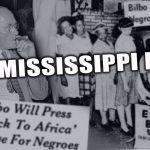
In 1946, Theodore Bilbo stood before a packed crowd in Greenville, Mississippi, and reminded them why he believed he deserved another term in the United States Senate.
The room was full. Every seat was taken. More people stood outside listening through a sound truck set up for the overflow crowd. Bilbo talked about Washington. He talked about race. He talked about keeping Black people in their place.
And most importantly, he talked about voting. For Theodore Bilbo, few issues mattered more than preventing Black political power. That was not a secret. It was the foundation of his political career.
Who Was Theodore Bilbo?

Theodore Bilbo served as both governor and United States senator from Mississippi. He was one of the most outspoken defenders of segregation in American politics.
Unlike many public officials, Bilbo rarely attempted to soften or disguise his views. He openly promoted white supremacy. He openly opposed Black voting rights.

He openly argued that Black Americans should be removed from the United States and resettled in Liberia.
Bilbo was also a familiar figure in Mississippi’s long history of racial injustice.
He pardoned Emmett Norwood, a white man convicted of brutally attacking and violating a seven-year-old Black girl. When the NAACP demanded investigations into racial violence, Bilbo frequently dismissed their concerns.

He once declared that Mississippi was “strictly a white man’s country, with a white man’s civilization” and insisted that Black aspirations for political and social equality would ultimately fail.
As disturbing as those statements are today, they were not politically disqualifying in Mississippi. They helped elect him. Twice as governor. And twice as senator.
The Meeting That Revealed Everything
During his 1946 campaign, Bilbo told supporters about a meeting he had held two years earlier with a delegation of Black leaders from Washington, D.C.
The group included attorney Belford Lawson, Dorothy Strange of the Washington Council of the National Negro Congress, religious leaders, labor leaders, and representatives from various Black organizations.
At the time, Bilbo chaired the Senate committee responsible for overseeing Washington. This was before the District of Columbia had the ability to elect its own local government. Congress exercised direct authority over the city, and Bilbo wielded considerable influence over its affairs.
The Black delegation came with a straightforward argument. Black Americans were fighting and dying in World War II. They were defending democracy abroad. Surely they deserved greater democratic participation at home. Bilbo was unmoved.
He later recalled telling the group that Black people had little to fight for and would continue to face discrimination throughout their lives.

He also informed them that after the war he intended to renew his efforts to send Black Americans to Africa.

Those comments alone reveal much about Bilbo’s worldview. But what he said next reveals even more.
Why Bilbo Feared Black Voting
While recounting the meeting to supporters in Greenville, Bilbo mocked the Black leaders who had come to see him.
Then he explained why he opposed expanding voting rights in Washington, D.C.
If Black people gained meaningful political power in the nation’s capital, he warned, Black Southerners might move there. The city could eventually elect Black leaders. Perhaps even a Black government.
For Bilbo, that possibility was unacceptable. His comments exposed something important. The issue was never simply voting. The issue was power. Political power. Representation. Influence. The ability of Black citizens to shape the governments that governed them. That was the outcome Bilbo feared. And that fear had deep roots in Mississippi history.
“Senator George Fixed That”
As Bilbo continued speaking, he reassured the crowd that Mississippi had already solved what he called the problem of Black voting. According to Bilbo, a previous Mississippi leader had “fixed” the state constitution after Reconstruction to ensure that Black people could not effectively exercise political power.
On that point, Bilbo was telling the truth. Following Reconstruction, Mississippi leaders developed what became known as the Mississippi Plan, a coordinated effort to restore white political control through intimidation, violence, election fraud, and eventually law.
The culmination of that effort came with Mississippi’s Constitution of 1890. The new constitution imposed literacy tests, poll taxes, residency requirements, and other barriers specifically designed to reduce Black voter registration. Supporters of the convention were remarkably honest about their goals. They openly stated that the purpose was to exclude Black voters from political life.
And it worked. Within a few years, Black voter registration collapsed across the state. The system Bilbo celebrated had succeeded.
More Than One Man’s Opinion
It would be easy to dismiss Theodore Bilbo as an unusually racist politician from another era. That would also miss the larger point. Bilbo was not speaking from the political fringe. He was a governor. A senator. A man repeatedly elected by the voters of his state. And when he spoke about Black voting rights, he was not describing a new idea. He was defending a system Mississippi had spent generations building.
That is why Bilbo remains important today. Not because he was unique. But because he was honest. He openly said what many others preferred to hide. He openly defended Black disenfranchisement. He openly celebrated the mechanisms used to maintain it.
And in doing so, he revealed a truth that runs throughout American history: The attack on Black voting rights was never accidental. It was policy.
To learn more about Theodore Bilbo, the Mississippi Plan, and the long struggle over Black voting rights in America, watch the full episode of Black Ballots & Barriers.